Let’s share thoughts, experience, initiatives and opinions!
The Fédération Mondiale du Cirque representing the worldwide circus community starts an overview and dialogue by focusing on different themes and aspects of our artform.
The first article is about “The economic and social role of the circus in Europe” .
We would like to open a channel to know more about these complex subjects in other continents as well.
We appreciate your comments, letters, and articles sent to [email protected]
The economic and social role of the circus in Europe
– a rethinking of an undervalued sector
For a long time, European circus arts have primarily appeared as a cultural phenomenon in policy discourse and public thinking, while their economic role – although existing and measurable – has typically remained in the background. This imbalance in perspective is particularly striking in light of the fact that, over the course of its more than two-and-a-half-century history, the sector has continuously adapted to changes in the social and economic environment, and today can be interpreted as a complex, multidimensional player within the creative industries.
A comprehensive analysis prepared a few years ago for the European Commission – initiated by István Ujhelyi, former Member of the European Parliament and circus ambassador of the FMC – sought precisely to fill this missing perspective by examining the circus not only as a cultural, but also as an economic factor. This was not merely another cultural policy document, but an unusually broad attempt to map the sector from several angles. In this respect, Europe occupies a special position: there are few, if any, comparable examples elsewhere in the world where the circus sector has been assessed so systematically through an institutional European policy framework, including its social and economic dimensions.
The starting point is clear: the circus “provides quality entertainment to millions and ensures livelihoods for tens of thousands of people,” while being “an integral part of the European economy.” This statement is not merely a rhetorical turn, but a structural fact supported by the available data.
According to the European Commission’s study, there are currently approximately 1,600–2,100 circus enterprises operating in the European Union, employing a total of 11,000–15,000 people – although this figure has evidently changed somewhat since the study was completed. At first glance, this number may not seem particularly significant in volume; however, considering the structure of the cultural and creative industries – where the dominance of micro-enterprises is typical – it can be regarded as particularly substantial.
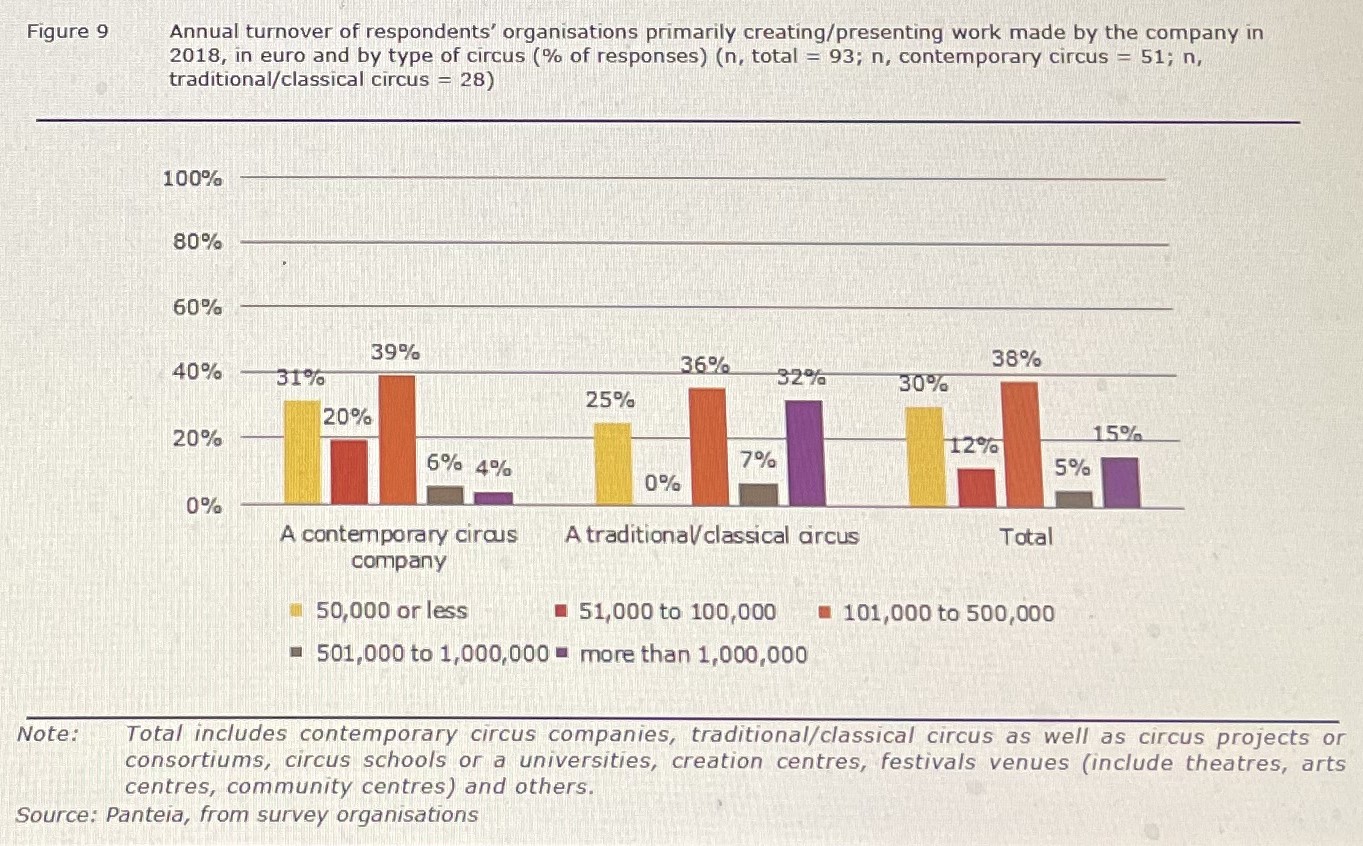
A further dimension of economic weight is provided by turnover and audience reach. Some of the companies examined generate annual revenues exceeding EUR 1 million, while one-third of the troupes attract more than 30,000 spectators per year. It logically follows that the circus is not a marginal form of entertainment, but a service with a significant consumer base and a stable revenue structure.
At the same time, it is important to nuance this picture. The sector is highly fragmented: alongside large, traditional troupes, a considerable number of smaller, often project-based contemporary circus enterprises are also present. This duality represents both strength and a challenge. On the one hand, it enriches the artistic and organisational landscape of European circus; on the other, it makes unified economic policy treatment more difficult.
The economic significance of the circus is not limited to direct revenues and employment. Equally important are the so-called multiplier effects, which appear in tourism, hospitality, transport and local services. One of the fundamental aims of the BigTopLabel programme is precisely to strengthen the link with the tourism sector and to raise awareness of the role of the circus as an attraction. This is particularly relevant in countries where circus performances form part of seasonal tourism offerings and contribute to increased visitor numbers.
In this regard, it is also worth briefly looking beyond Europe. In China and Mongolia, circus arts – partly with state support – have become a tool of national cultural export, while in the United States, large-scale productions, for example resident shows in Las Vegas, form an integrated part of the entertainment industry, generating significant tourism revenues. Although these models cannot be transferred in all their elements to the European environment, they clearly demonstrate that the economic potential of the circus extends far beyond traditional cultural frameworks.
This is also where the European experience may offer a useful reference point for countries outside Europe. The preservation of circus heritage is becoming an increasingly visible topic in several national cultural strategies, but the socio-economic role of the circus has rarely been articulated in such a structured way. The European example therefore opens a door to a broader discussion: when governments and institutions assess the value of circus arts, they should take into account not only questions of heritage, culture and identity, but also employment, tourism, local economies, education, innovation and community-building.
One of the most important and often underestimated resources of the circus is its capacity for adaptation and renewal. Over recent decades, the sector has continuously responded to changing consumer demands, technological possibilities and the regulatory environment. The European Commission’s analysis clearly pointed out that innovation “is one of the defining factors of the circus’s success.” This innovation appears at multiple levels: artistic, technological and organisational.
At the same time, the tension between traditional and contemporary circus cannot be ignored, but it should not be reduced to a simple hierarchy of innovation. Contemporary circus often operates with a more experimental, conceptual and theatre-like language. It tends to search more visibly for unusual forms of expression, interdisciplinary approaches and new dramaturgical structures. It is also often more experienced in project-based cultural financing, international grant applications and institutional networks.
Traditional circus, by contrast, usually rests on more direct market exposure and a more stable audience-based economic model. Precisely because of this, it is also under constant pressure to adapt: to renew its shows, modernise its communication, respond to changing audience expectations, comply with evolving regulatory environments, and maintain relevance in an increasingly competitive entertainment market. In other words, innovation is present in both models, but it takes different forms. The real question is not which model is more innovative, but how the sector can recognise the different types of renewal taking place within it and turn this diversity into a strategic advantage.
The exploitation of the sector’s economic potential is significantly influenced by the regulatory environment. One of the fundamental problems is that the status of the circus differs from one Member State to another: some treat it as a cultural sector, while others regard it more as a business activity. This heterogeneity hinders the development of unified development and financing strategies.
Access to EU funding is also limited, and this must be clearly stated – not for the first time. Although Creative Europe and other programmes are, in principle, open to circus projects, the sector’s participation is low, partly due to a lack of information and partly due to administrative burdens. At the same time, it is evident that financing problems cannot be attributed solely to external factors. The lack of proactive coordination within the sector, limited willingness to cooperate, and the restricted effectiveness of joint interest representation also contribute to the current situation.
In this context, initiatives such as BigTopLabel – which create quality standards and a shared platform – are of strategic importance not only from a cultural, but also from an economic perspective. Especially if the profession itself views and uses them as such.
Based on the available data and analyses, it can be clearly stated that the economic role of the circus in Europe is undervalued. Although the size of the sector cannot be compared to that of major industries, its complex system of impacts – from employment through tourism to innovation – justifies examining it not only from a cultural policy, but also from an economic policy perspective.
At the same time, it is also clear that the future of the circus does not depend solely on external recognition. The sector’s internal adaptability, willingness to cooperate, and strategic thinking are at least as decisive. In this sense, the current situation is not only a challenge, but also an opportunity: to reinterpret its own narrative and, building on its cultural heritage, to occupy a consciously constructed economic position on the map of the European creative industries – while also offering a model that may be relevant beyond Europe.
Tamás Lajos Szalay
(creative coordinator of BigTopLabel)